For years, I've been wishing for a small, low power home NAS to hold of all my data securely. The range of mini-ITX systems has intrigued me, but finding a suitable case that can hold a bunch of disks has been difficult.
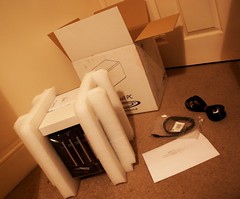 Recently, I ordered a barebones system from
Tranquil PC,
the
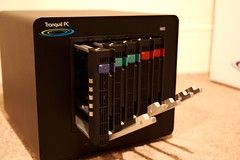
BBS2 after a recommendation from Jon Fautley. It's a mini-ITX system
inside based on the
Intel D945GCLF2 motherboard with a HT-enabled dual core Intel
Atom 330 CPU.
Recently, I ordered a barebones system from
Tranquil PC,
the
BBS2 after a recommendation from Jon Fautley. It's a mini-ITX system
inside based on the
Intel D945GCLF2 motherboard with a HT-enabled dual core Intel
Atom 330 CPU.
The system has five removable drive caddies, some connected to the motherboard, some a fitted Silicon Image SIL3124 RAID card, plus an eSATA port available on the back for further expansion. The model I chose was configured with the eSATA port and three of the drive caddies connected to the RAID card and the other two on the motherboard.
The order from Tranquil PC was straight forward, though as they apparently build them to order, it took about nine working days for the system to arrive (including snow!).
I'd like to run OpenSolaris on the system to get all of the advantages of ZFS: regular, automatic snapshots, NFS and CIFS file sharing and RAIDZ. So far, I've been unsuccessful in trying to use the automated installer as my network didn't support the multicast required for DNS service discovery.
Instead, using these instructions, I easily created a USB stick that the machine could boot from to run the OpenSolaris installer. It's worked perfectly so far and the system's up and running on a test disk.
The next step is to order some HDDs for it to store the data pool on, then begin configuring the system. The drives I have in mind are the Western Digital Caviar "Green" drives, which have a very low power consumption compared to other drives.
| Drive | Read/write consumption | Idle consumption | Standby consumption | Maximum operating temp |
|---|---|---|---|---|
| WD Caviar Blue 750GB | 8.77W | 8.40W | 0.97W | 60°C |
| WD Caviar Green 1TB | 5.4W | 2.8W | 0.4W | 55°C |
 The main compromise with these drives that may affect this system seems to be
the maximum operating temperature. As the system is very compact (much like a
Shuttle PC), Jon reported his drive temperatures reaching the high 40s, so the
lower max rating is a little concerning. Hopefully the considerably
lower power usage reduces the overall cost of the system.
The main compromise with these drives that may affect this system seems to be
the maximum operating temperature. As the system is very compact (much like a
Shuttle PC), Jon reported his drive temperatures reaching the high 40s, so the
lower max rating is a little concerning. Hopefully the considerably
lower power usage reduces the overall cost of the system.
I'll try and add more info about how the machine's set up as I progress with the install and configuration of OpenSolaris 2008.11 in the hope that it helps somebody!
More photos: m0dlx's photostream: BBS2 Home NAS
Other related posts: